

How outrage, obsession, and reaction quietly turn competent adults into puppets
Most people believe the greatest insult is being lied to, cheated, or manipulated.
Not so.
The greatest insult is far more humiliating and far more common… and worse, it’s self-inflicted: handing control of your thoughts, emotions, and cardiovascular system to someone you openly detest.
Millions of intelligent, capable adults are doing exactly this every day.
Not because they’re weak, but rather because they’ve confused outrage with power, vigilance with control, and righteous indignation with virtue.
The Clouseau Effect – A Scientific Term I Just Invented
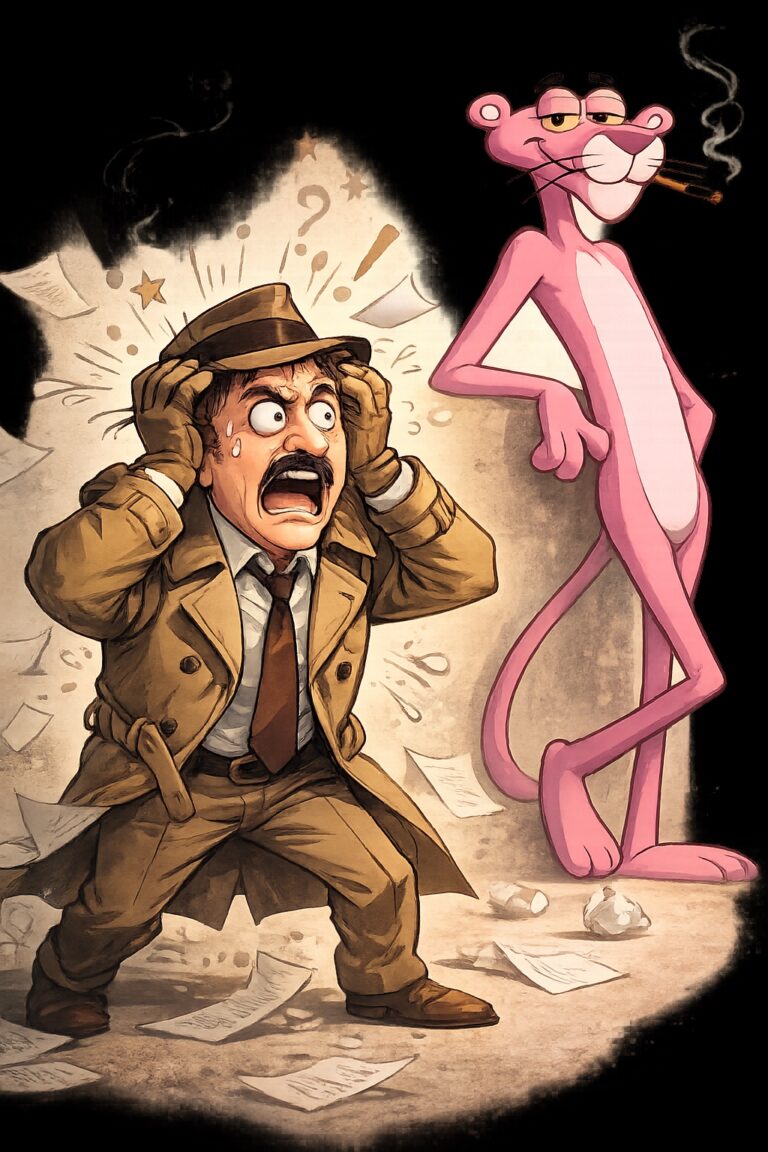
When I see people stressed and obsessed – to the point where it’s visibly harming their health, I can’t help but think of the Pink Panther films from the 1970s. A sequel, featuring a highly competent senior detective who slowly loses his mind because of a bumbling subordinate who keeps accidentally succeeding at life.
Inspector Dreyfus had enjoyed a long and distinguished career. He was intelligent, disciplined, respected. He solved crimes using his intellect, played by society’s rules, and was rewarded accordingly. Everything worked as it should. Everything made sense… until Clouseau arrived.
Suddenly, the serious, rule-abiding professional is unwittingly one-upped at every turn by a man whose greatest skill is falling upward. What makes it both tragic and hilarious is that Clouseau is completely unaware of the effect he’s having.
With childlike innocence, Clouseau enjoys his successes and shrugs off his failures as part of life. Meanwhile, brilliant, accomplished Dreyfus, develops a facial tic, neurosis, and a demonic mission to wipe Clouseau out of existence. The more Clouseau succeeds (the puppeteer) the more Dreyfus (the puppet) unravels. By the end, Dreyfus is building a doomsday weapon in his castle. Not metaphorically. An actual doomsday weapon. In an actual castle.
It’s the perfect metaphor for our times, except people don’t bother with castles and weapons, they’re perfectly okay with destroying their blood pressure.
Life in the clutches of a puppeteer
Not long ago, I was mowing my lawn when my neighbour Jack and his daughter April walked by. I hadn’t seen them in months, so I shut off the mower to say hello.
When I asked how things were going, April replied “great” with enthusiastic sincerity. Jack, however mumbled something along the lines that he was surviving.
He wasn’t kidding, he looked worn-out and done in.
When I asked what was wrong, he stared at me in disbelief.
“Haven’t you heard what Trump said a few days ago?”
When I said I hadn’t, he suggested I should really be watching the news, because as far as he was concerned, Trump was leading us straight toward nuclear annihilation.
With a deep sigh – the kind reserved for explaining the obvious to the village idiot – Jack launched into a lecture about Ukraine, Trump, Putin, and the inevitable World War III. His voice rose, his hands gestured wildly and then, quite suddenly, his lips began to quiver. His eyes welled up.
He was so wound up he had to stop mid-sentence and collect himself.
“Jack,” I said, “maybe you should stop watching the news.”
“That’s what I told him!” April jumped in. “He gets so upset it’s affecting his health.”
Jack waved us off with a dismissive gesture, that suggested he was choosing to bear the burden and suffer for the sake of humanity.
After getting himself together he said he had to follow the news. How else could he keep an eye on Trump and subsequently protect his stock portfolio.
We debated Trump and his policies for another half hour until Jack finally had enough and he threw up his hands in frustration and stormed off.
The Face Will Change… but the Pattern Won’t.
A few weeks after that lawn-side intervention, my wife and I went to a friends’ for dinner.
Before we’d even taken off our coats, our host announced a firm rule for the evening: no talking about Trump.
I shrugged and said that was perfectly fine as neither my wife or me had the slightest desire to discuss Trump. And then, not surprisingly, within 20 minutes our host managed to weave Trump into the conversation, and as things went, Trump was all we talked about for the rest of the night.
At one point, I suggested, perhaps unwisely, that maybe Trump wasn’t entirely insane. That perhaps he had reasons – however imperfect – for wanting to steer America in a different direction.
The effect was instantaneous.
My friend’s voice began to shake. His hands trembled. His wife rolled her eyes and gave me The Look. The one that said, “thanks a lot, here we go again.”
I wasn’t trying to defend Trump. I was trying to introduce the radical concept that perhaps not every decision made by someone you dislike is the product of pure malevolence or clinical insanity. But in his mind, there was no room for discussion.
These aren’t isolated cases. Scroll social media. Read the comments. Listen to podcasts. Attend a dinner party with people who promised not to talk about politics. You’ll see otherwise intelligent people losing all sense of proportion over something Trump said, allegedly did, or looked like he might do based on a three-second clip taken wildly out of context.
The media and the Clouseau Effect: A love story
When Trump first entered the political arena in 2015 the media got addicted to the ease with which they could write teasing and scathing articles about the new magnetic novelty who – although considered a long-shot at best – was irresistible to ignore.
So, they wrote, and wrote, and wrote.
Each article was easier than the last. Trump said outrageous things! People clicked! Ad revenue flowed! What could possibly go wrong?
Then the unthinkable happened. The “long shot” became the leading Republican candidate. By 2016, the media had gifted Trump billions of dollars in free exposure.
Still, they weren’t concerned, after all, since they created the monster they could also destroy it at will.
The best laid plans of mice and men…
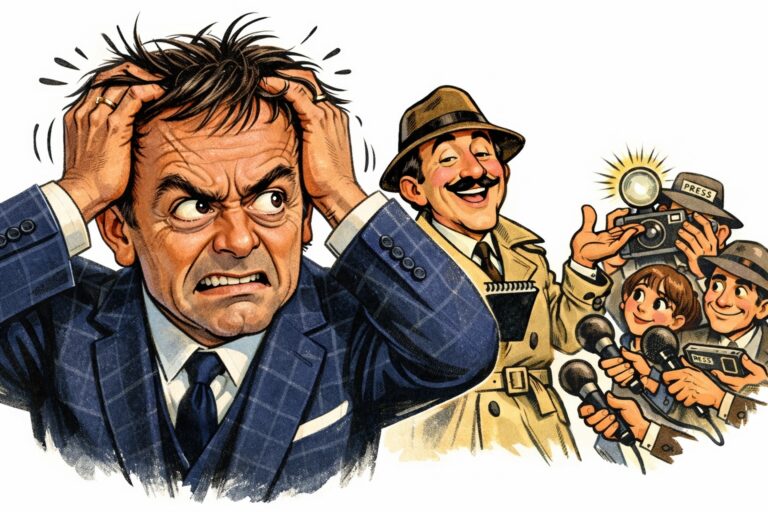
The Megyn Kelly debate-moment perfectly captured the media’s predicament.
During the first Republican primary debate in 2015, Kelly – then a Fox News moderator – asked what was widely believed to be a devastating, campaign-ending question. With consummate confidence she confronted Trump about his past comments toward women, quoting him directly:
“You’ve called women you don’t like ‘fat pigs,’ ‘dogs,’ ‘slobs,’ and ‘disgusting animals.’”
The expectation was obvious. Trump would stumble. He would apologize, backpedal, attempt to explain himself, or be publicly shamed into political oblivion. The playbook of political discourse dictated that he would express contrition, promise to do better, emerge chastened.
Instead, Trump paused, smiled, and deadpanned:
“Only Rosie O’Donnell.”
The audience erupted in laughter. The moment went viral. Media coverage exploded.
What was meant to expose and destroy him did the opposite. It humanized him to supporters, amused the undecided, and demonstrated that Trump refused to play by the rules the media assumed he would obey.
More importantly, it revealed something far more unsettling: the harder the media pushed, the more power they handed him. Their outrage didn’t weaken him, it amplified him.
It was the Clouseau Effect in real time. The media kept throwing him hand grenades which he refused to catch. The more desperate they got, the more unhinged they became the more success Trump enjoyed.
Trump wandered around being completely unbothered, occasionally saying “Only Rosie O’Donnell” and a large part of the nation couldn’t stop laughing.
Trump delights in mocking the media, tossing out contradictions like confetti, and watching people contort themselves in response. And there’s no shortage of people twisting themselves into intellectual pretzels, fact-checking obvious jokes, writing 3,000-word essays about a tweet, sacrificing their mental health on the altar of Being Right On The Internet.
Meanwhile, Trump golfs.
No one is unhappier than a person being controlled
Years ago, a close friend of mine was dumped by his fiancée. Not a small event. Anyone would struggle with that.
But a year later, I was still hearing about that bitch ad nauseum.
One night, after listening to the usual rant, we headed out to watch the World Cup final. My friend, being a huge fan, managed to temporarily forget her and he began talking excitedly about the upcoming match.
After enjoying a few minutes of my friend – finally being his old self – I stopped the car and asked if we should go back to my place. ‘
“For what?”
“To get your baggage,” I said. “You don’t want to go anywhere without your ex-fiancée baggage do you? How can you possibly enjoy yourself without your misery kit? What if something good happens and you’re not prepared to ruin it by thinking of her?”
“Fuck-off,” he laughed.
But that little sequence, that moment of seeing himself from the outside, finally broke the spell. For the rest of the night – and from then on, he was finally over her.
He got his life back, and I got my old friend back.
Personal control is the only antidote
The Stoics – those ancient philosophers who basically invented the concept of not getting all worked up over little issues – urged us to focus on one chief task: separating what is within our control from what is not.
The Serenity Prayer says it more poetically;
God, grant me the serenity to accept the things I cannot change, the courage to change the things I can, and the wisdom to know the difference.
There can be no greater waste of a human life than stewing over things we cannot control. It’s like being angry at the weather – which I catch myself doing from time to time.
This doesn’t mean we shouldn’t care about the world. That we shouldn’t engage, vote, take a stand for something meaningful, or work toward change where change is possible.
But wallowing in self-righteous outrage, living in permanent indignation, sacrificing our health and sanity while convincing ourselves we’re the rational guardians of order – that’s not virtue. That’s volunteering to be someone’s puppet. That’s handing your strings to someone who doesn’t even know you exist and saying, “Here, give these a yank whenever you’d like.”
If you’re at home on a Saturday night churning with anger over your boss, an ex-lover, the relative from hell, or anyone else who is controlling your thoughts and emotions, while they’re out golfing, dancing, and living their lives – completely unbothered – it may be time to have a quiet conversation with your more rational self.
Ask yourself: Who’s really in control here?
And the thing that adds insult to injury, that thing that makes it the ultimate insult is this… it’s entirely self-inflicted.
You’re not a puppet because someone is forcing you to be. You’re a puppet because you picked up the strings and handed them over, convinced that your suffering was somehow noble, and that your outrage is a form of resistance.
And maybe that’s the part worth sitting with.
Not who you’re angry at.
Not whether your outrage is justified.
But why someone who doesn’t even know you exist determines how you feel on a Tuesday afternoon.